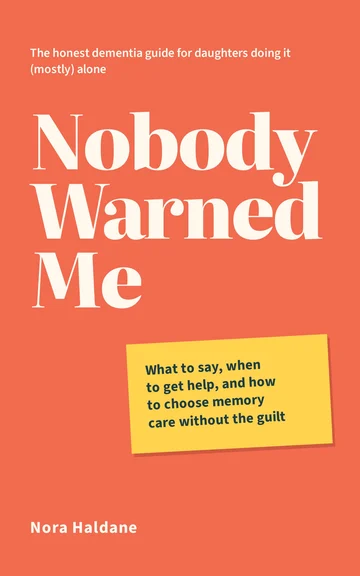
Nobody Warned Me
The honest dementia guide for daughters doing it (mostly) alone. What to say, when to get help, and how to choose memory care without the guilt.
The books said she might forget your name. They didn't say she would accuse you of stealing her purse at 2 a.m.
If you're the daughter who handles the appointments, the pills, the bills and the late-night calls, while your siblings check in once a month to say she "seemed fine," this book was written for you. It's honest about how hard this gets, specific about what to do, and it gives you permission to stop doing everything yourself.
What's inside
- "Nobody warned me it would be like this." What's actually happening in her brain, in plain words, and why it isn't personal.
- "She says I'm stealing from her." Scripts for accusations, paranoia and the go-home loop.
- "I haven't slept in weeks." Sundowning, night wandering and the fight over showers.
- "She won't admit anything's wrong." Getting a diagnosis and a power of attorney when she insists she's fine.
- "My brother can't." Family meetings, real jobs for far-away siblings, and planning around the ones who won't help.
- "Where's the money supposed to come from?" What Medicare doesn't pay, Medicaid basics, VA benefits and when to call an elder-law attorney.
- "I'm going to lose my job." Keeping your work, and handing off what you don't have to do yourself.
- "Am I a monster for wanting to place her?" Clear signs it's time for memory care, choosing a place, and the first 30 days.
- "I don't even like her anymore." Caring for a parent who was difficult or hurtful long before the dementia.
- "What if I didn't do enough?" The late stages, hospice, and the guilt that can follow you afterward.
Every chapter opens with a one-minute version, because some nights that's all you have.
Formats
- Paperback, 130 pages, 6 x 9 in. ISBN 9798163766482.
- Kindle eBook, also free to read with Kindle Unlimited.
A note on how it was made
This book was written with the help of AI tools, then checked against the sources listed in its Resources chapter: the Alzheimer's Association, the National Institute on Aging, Medicare and similar organizations. The stories in it are composites of what caregivers commonly describe, not real people. It isn't medical or legal advice, and it says so wherever that matters. More on that on the About page.